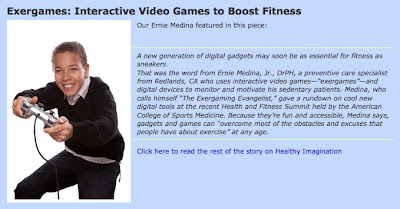
Thx to Steven Yang for posting on our TEN blog! Here's the article of an interview I did. You can read the full article here.
Sunday, June 12, 2011
Interactive tools for fitness
Thx to Steven Yang for posting on our TEN blog! Here's the article of an interview I did. You can read the full article here.
Tuesday, May 31, 2011
Latest CA PE report
Ernie
***************************************
Good afternoon Fit 2Gether partners and LIAs,
Last one for the day. Thought you may be interested in the Health Policy Brief from UCLA Center for Health Policy Research. See summary below, and the policy brief attached or visit, http://www.healthpolicy.ucla.edu/pubs/files/adolescentpepb.pdf. …Pam
FYI: CA recommends 200 minutes/every 10 days for elementary and 400 minutes/every 10 days for middle & high school, but NASPE recommends 150 minutes/week plus one 20 minute recess/day for elementary and 225 minutes/week for middle & high school.
__________________________________________________________
May 2011
Adolescent Physical Education and Physical Activity in California
Allison L. Diamant, Susan H. Babey and Joelle Wolstein
S UMMA R Y: In California, more than 1.3 million adolescents (38%) do not participate in physical education (PE) at school, and this rate increases dramatically with age, from just 5% at age 12 to 77% at age 17. In addition, only 19% of teens meet current physical activity recommendations. Participation in PE at school is associated with more overall physical activity. Policies that promote more opportunities for physical activity, including those that help schools meet or exceed current PE requirements, can contribute to greater levels of physical activity for adolescents.
Sunday, May 22, 2011
Can Wii make you fit?
http://www.myhealthnewsdaily.com/can-wii-make-you-fit-the-arguments-for-and-against-1530/
Healthy Business — Special Report — Game Makers Push Fitness To Health Clubs - CNBC
As for Fuze Fit's Dave Jame's comments on kid's picking the Trampoline over the Wii, it's too bad that they didn't print the rest of what he probably said: that there are a lot of other kids who would prefer the wii over the trampoline!
The bottom line is that we need to use ALL the tools available to us--exergaming tools AND traditional exercise tools--to get kids to move more. Just because some kids choose the trampoline over the Wii doesn't mean exergames are a waste--NO! As long as they are moving more than they were...that's the key!!!
In my experience with the Xrtainment Zone, our kids overweight classes (Family Fit Zone), & our classes at Beaver Med Group, exergames DO reach kids who aren't into the traditional, so I'm grateful we have this tool to use!
Ernie Medina, Jr., DrPH
Exergaming Interventionist
MedPlayTech.com
Thursday, May 12, 2011
Can exergames replace treadmill?

5-12-11 Thx to Exergaming Evangelist from Down Under, Brett, for tweeting and posting this on FB!
Heart Rate and Perceived Exertion During Self-Selected Intensities for Exergaming Compared to Traditional Exercise in College-Age Participants
Kraft, Justin A; Russell, William D; Bowman, Tracy A; Selsor, Clifford W III; Foster, Grant D
Check out this just published article in the Journal of Strength and Conditioning Research, March 2011.They compared workouts on DDR and Gamebike to treadmill and here's what they found:
"Results support that exergames are capable of eliciting physiological responses necessary for fitness improvements. Practitioners might consider exergames as periodic activity options for clients needing motivation to be regularly active."
The evidence just keeps coming out that certain exergames CAN reach the MVPA level!
Monday, May 9, 2011
Games for Health conf. less than wk away!

The 7th Annual Games for Health Conference in Boston, MA is May 17-19, now just over one week away!
Over three days we have scheduled over 100 talks covering a complete gamut of opportunities for videogames and videogame technologies in health and healthcare.
Registration fees will be rising soon. Register today and receive 10% off the current ticket price using the discount code BOST11.
To see schedules and register visit: http://bit.ly/gfh2011
FREE PASS OFFER
To see if you qualify for our free pass for sensor-based developers and researchers visit: http://bit.ly/mLR3De
CONFERENCE HIGHLIGHTS
Three days featuring 120+ speakers and over 80 talks, two networking receptions, contests, group activities, and more.
Positive Psychology -> Positive Computing -> Positive Videogames
Dr. Martin Seligman, The Positive Psychology Center, University of Pennsylvania
"The Last Mile Doesn't Have to be the Hardest: Solving Problems Between Games and Health"
Dr. Roni Zeiger, Google
"Gaming Your Way to a Healthier Lifestyle" by Shellie Pfohl, Executive Director, The President's Council on Fitness, Sports and Nutrition
To see the latest scheduled sessions please visit:
http://www.gamesforhealth.org/
For up-to-date conference information please visit:
http://www.gamesforhealth.org/
GAMES FOR HEALTH FEATURES THREE DAYS OF EVENTS...
May 17: Pre-conference Events & Workshops
- Out & About II: Mobile Serious Games
- Ludica Medica I: Game-based Medical Modeling, Simulation & Education
- Enabled Play: 4th Annual Games Accessibility Day
- NEW!!! Games for Health Sensor Day
Multiple tracks of great content including...
- Open Content Tracks
- Exergaming & Active Gaming
- Cognitive & Emotional Health
- Sensorimotor Rehab
- Nutrition & Games
- Social Games & Virtual Worlds
- Sensor Games for Health
Registration fees will be rising soon. Register today and receive 10% off the current ticket price using the discount code BOS11.
To see schedules and register visit: http://bit.ly/gfh2011
ABOUT GAMES FOR HEALTH
Founded in 2004, the Games for Health Project supports community, knowledge, and business development efforts to use cutting-edge games and game technologies to improve health and health care. The Pioneer Portfolio of the Robert Wood Johnson Foundation is the lead conference sponsor and a major supporter of the Games for Health Project. To date, the project has brought together researchers, medical professionals, and game developers to share information about the impact games and game technologies can have on health, health care, and policy.
A major effort of the Games for Health Project is the annual Games for Health Conference. Over three days, more than 400 attendees will participate in over 60 sessions provided by an international array of 80+ speakers, cutting across a wide range of activities in health and health care. Topics include exergaming, physical therapy, disease management, health behavior change, biofeedback, rehab, epidemiology, training, cognitive health, nutrition, and health education. The Games for Health Project is produced by the Serious Games Initiative, a Woodrow Wilson International Center for Scholars effort that applies cutting-edge games and game technologies to a range of public and private policy, leadership, and management issues.
Monday, April 25, 2011
Exergaming in AHA's Circulation journal!

4-25-11: My job in the clinic doesn't require me to publish like my academic colleagues, so it's cool to see something published that I co-authored with legends Debra Lieberman and Barbara Chamberlin, and others. This particular article contains a summary of exergames, state of field, and future considerations.
This was published from our presentation during the 2nd day of the Power of Play Summit, hosted by the

Amer. Heart Assoc., and Nintendo. (These are pictures from the summit held Jan. 2011.)

You can check out the actual article here.
